This buyer guide is written for decorative, costume and promotional custom masks. It is not guidance for medical, surgical or respiratory protective equipment.
Introduction
Choosing a custom mask manufacturer is less about finding a factory that can make something visually similar to a reference image and more about finding a partner that can turn that image into a controlled, repeatable product. For decorative, costume, promotional and retail masks, the risk usually sits in interpretation: material, weight, edge finish, logo treatment, fit, accessories, packaging and final inspection can all change how the finished item is received by a customer.
The best starting point is a structured buyer brief. It does not need to be a complete engineering pack, but it should explain the intended product application, target market, expected quantity, delivery timing and any visual references. That gives a manufacturer enough information to identify the questions that should be answered before a sample is made.
1. Define the product application before comparing factories
The same mask concept can require very different production decisions depending on where and how it will be used. A retail collection may need a controlled decorative finish, protective presentation and repeatable packing. An event mask may prioritise the handling experience, distribution count and campaign timing. A hospitality or venue project can raise questions about comfort, attachment method and how the mask will be stored between uses.
Tell each supplier what the product needs to do, not only what it needs to look like. A useful request can include reference images, front and rear views, dimensions if available, target quantity, destination market, use scenario and the details that cannot change. When a buyer provides only one image and a price target, the resulting quotation is likely to contain assumptions that are discovered only after sampling.
A practical RFQ identifies the intended use, quantity range, destination market, required date, visual reference, material direction, logo treatment and packing requirement. Ask each supplier to state its assumptions in writing.
2. Check whether the factory can translate design into a production route
A capable custom mask manufacturer should be able to discuss the route between a concept and a production-ready item. That discussion may cover material options, construction, mold or tooling requirements where relevant, surface treatment, accessories, sample stages, quality checkpoints and packing. The goal is not to force a factory to give a final answer before it has seen the full brief. It is to understand how the factory reasons through the work.
Ask what information the supplier needs before making a quotation, what it would verify during development and what changes could affect the production route. For example, a deep sculpted surface, mixed-material build, metallic coating, embossed logo or custom box may each introduce a separate approval step. Good suppliers explain these dependencies rather than offering an overconfident all-in answer before the design is understood.
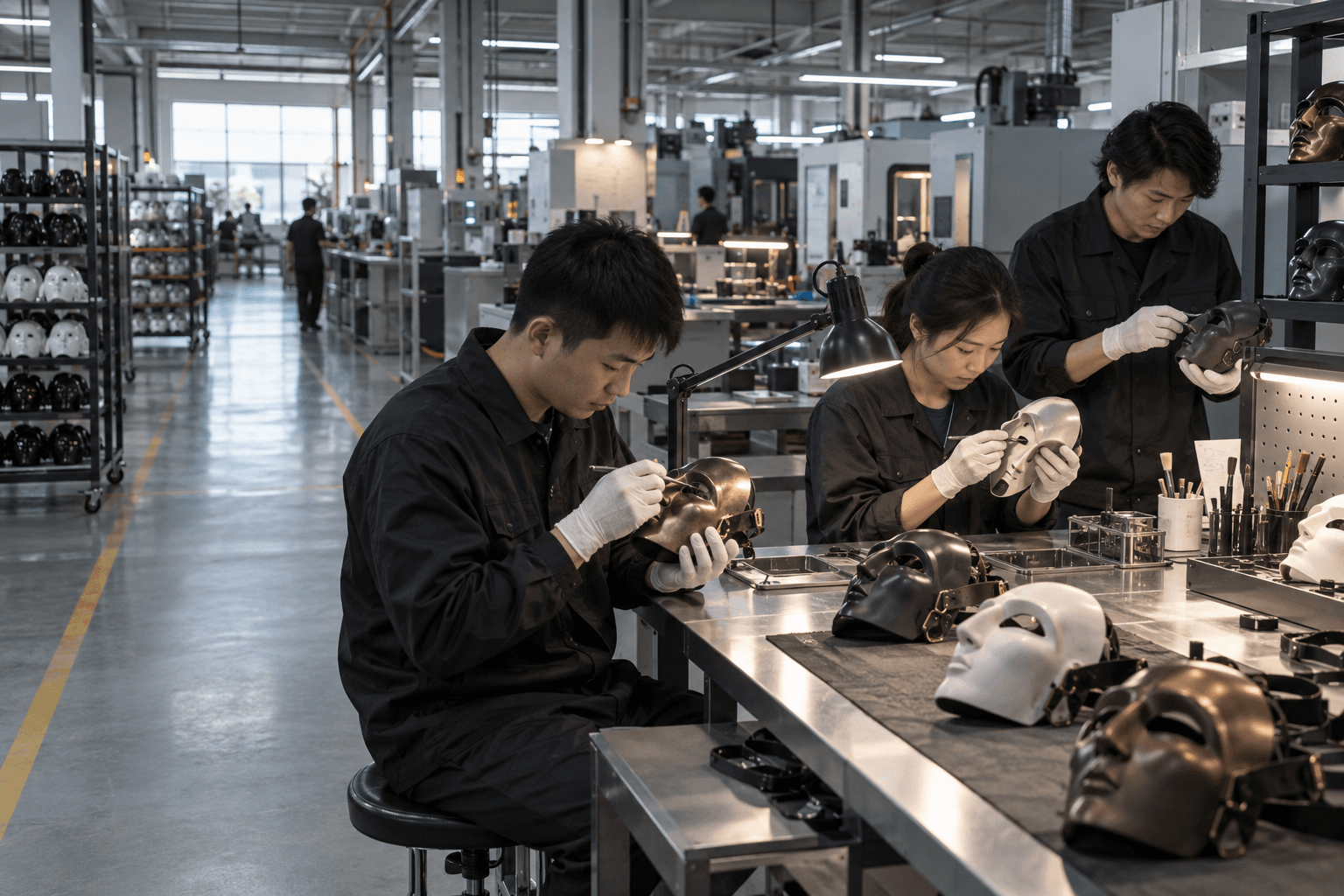
When reviewing a factory, look for evidence that design, sample work, production and inspection are connected. A facility can have a large floor area and still rely on disconnected handoffs. For buyers, the practical question is whether the approved reference follows the product through the operation. MaskVox's Shenzhen factory page shows the route we use to keep design translation, sample review, production inspection and export packing connected.
3. Separate OEM, ODM and private-label expectations
OEM, ODM and private label are commercial labels, not a universal promise of the same work. In a custom mask project, OEM commonly means the buyer brings a defined product direction and the manufacturer produces it. ODM commonly means the manufacturer contributes more to the development of a workable product direction. Private label usually describes the brand and selling arrangement, and can involve either route.
Before comparing quotes, ask the supplier which parts of the project are being treated as buyer-supplied and which parts are being developed by the factory. A reference image may be enough to begin an ODM conversation, but it is not automatically a production specification. An OEM route may work well when the buyer already has approved design files, measurements, material instructions and packing artwork.
The distinction matters because it changes the questions, timing and budget drivers. Development work may require more sample feedback; a mature design may move more quickly into pre-production review. Neither route is inherently better. The right choice is the route that makes assumptions visible before an order is released.
4. Ask material and finish questions in product terms
Material selection should be discussed in relation to the product application. Resin may be considered when sculpted detail and a broad range of surface finishes are central to the object. EVA may be considered where a lighter or more flexible feel is relevant. PU, fabric, metal elements and mixed-material builds can create different tactile, visual and structural results. A factory should explain the trade-offs of each option for the specific design rather than treating one material as universally best.
Ask how the material affects weight, rigidity, edge comfort, surface detail, colour treatment, durability in normal handling and packing. If the buyer expects a matte, plated, printed, embossed or textured effect, the sample should show that finish in a form close enough to the intended production outcome to support a meaningful decision.
For products entering consumer markets, destination-market rules also matter. The European Commission's general product compliance guidance explains that manufacturers and importers need to consider applicable requirements, technical documentation, traceability and consumer information. That is not a substitute for product-specific legal advice, but it is a reason to identify the market and intended consumer early rather than after packaging artwork is finished.
5. Treat the sample as a working reference, not a showroom piece
The most useful sample is a decision tool. It should let the buyer check the details that are hard to judge from a drawing: overall form, scale, surface character, material feel, edge finishing, logo placement, accessories and any packing element that affects the customer experience. A sample also lets the factory identify issues that were not obvious in the initial reference.
Agree on what the sample is meant to prove. If a buyer is approving a shape-only prototype, do not assume that surface finish or packaging is also final. If the sample includes a specified finish and logo treatment, document the approval with photos, a revision note or a signed reference process. This creates a clearer bridge between customer requirements and bulk production.
Factory testing does not always mean laboratory testing. In a decorative mask project, it can include practical review of fit, attachment security, surface response, packing protection and repeated handling. The correct test plan depends on the product application. Avoid promising a performance claim unless the project has an appropriate standard, method and evidence behind it.
6. Make quality control visible before production starts
Quality control works best when the buyer and supplier agree on what will be checked. “Good quality” is too vague to inspect. A more useful control list identifies the visual and functional details that define acceptance: color direction, finish level, visible surface defects, logo location, accessory placement, product count, packing method and carton marking.
Ask when inspection happens and what reference is used. In-process checks can identify production drift before packing begins. Shipment inspection can compare finished items and cartons against the approved reference and packing list before handover. The exact sampling level and method should be appropriate to the order and agreed with the parties involved; do not assume a generic inspection percentage applies to every mask project.
PLAN THE PROJECT
Need a practical material or production route?
Send your reference, quantity and delivery market. We will identify the questions worth resolving before sampling.
Send your requirementsIf a buyer needs a third-party inspection, state that early. The supplier will need to plan access, timing, packing status and the documents the inspector will need. The goal is to avoid a situation where a finished order is packed, collected or booked before the acceptance points are clear.
Turn approvals into a usable production reference
The buyer does not need to create a complex quality manual for every program. A concise approval pack is often enough: dated photos of the approved sample, a short list of critical points, the version of the artwork, packing instructions and the agreed quantity breakdown. Where colour is important, keep the physical or digital reference clearly identified. Where an accessory is important, show its position and attachment point rather than relying on a general description.
This pack should be understandable by someone who was not in the original design call. That is a useful test. If an inspector, production coordinator or replacement buyer cannot tell which finish, logo size or carton label is approved, the instruction is too open to interpretation. Clear references are one of the simplest ways to prevent a small visual decision from becoming a late-stage dispute.
For a repeat order, review the previous approval pack rather than assuming it is still correct. A buyer may have changed a logo, destination, pack count or finish expectation since the first run. Recording the change before production starts protects both parties and makes the repeat program more reliable.
7. Include packing and export handover in the supplier evaluation
Packing is part of the product, especially when the item has a decorative surface, accessories or a retail presentation requirement. Ask how individual products will be separated, what protective material will prevent surface contact, how inner packs are counted and how outer cartons will be marked. Photos of packing preparation can be useful, but the agreed configuration should still be documented.
For export handover, clarify whether the buyer uses a nominated forwarder, what collection information is needed and which documents are expected. If pallets, crates or wood dunnage are used, confirm the applicable destination requirements. The International Plant Protection Convention provides guidance on ISPM 15 for wood packaging material used in international trade; responsibility and applicability should be confirmed with the relevant logistics and regulatory parties.
The best factory relationship does not remove the buyer's responsibility to specify the market and delivery route. It makes the handover more predictable by raising the right questions before cartons are sealed.
8. Compare quotations by assumptions, not headline price
A low quotation can be difficult to compare if the supplier has assumed a different material, finish, sample route, packing configuration or inspection scope. Ask every supplier to state what is included and excluded. This does not require a complicated procurement system; a simple side-by-side comparison can identify whether the products being priced are actually comparable.
Useful comparison points include the proposed material, development scope, sample inclusions, custom branding method, accessory assumptions, packing configuration, tooling or setup items where relevant, quality checks, delivery terms and what information is still required before a final order confirmation. Review these points with the same care as the unit price.
For a new supplier relationship, start with a manageable project or sample route where practical. It creates an opportunity to assess communication, revision control, product application understanding and shipment inspection discipline before the business depends on a larger repeat program.
9. Evaluate communication as part of manufacturing capability
In custom work, communication is a production input. A supplier that asks useful questions about the reference, material, use case and destination is not necessarily making the process slower. It may be exposing decisions that would otherwise appear after the order has started. Conversely, a very fast quotation that does not identify any assumptions may be difficult to manage because the price and timeline can rest on an incomplete product definition.
During the enquiry and sampling stages, observe how the factory records revisions. Does it identify artwork and sample versions? Does it summarize open points after a call? Does it explain what is ready for approval and what is still exploratory? These habits matter when an order involves multiple teams, branded packaging, more than one SKU or a fixed campaign date.
Time-zone responsiveness is useful, but clarity is more important than the number of messages. Ask for a named commercial or project contact and agree how approvals will be issued. A short written recap after each decision stage can be more valuable than a long chain of informal messages, particularly when the product is moving from concept to bulk production.
10. Questions to use in a first supplier call
Use these questions to structure an initial discussion with a prospective custom mask manufacturer:
- Which product details do you need to confirm before you can recommend a material and construction route?
- What will the first sample prove, and which details would need a later pre-production reference?
- Which visual points will be checked during production and during shipment inspection?
- How will you protect the finish, accessories and branding during inner packing and export packing?
- Which buyer decisions could change price, timing or the production route?
- What information do you need about the destination market, forwarder and required delivery date?
The goal is not to test whether a supplier has a scripted answer. It is to see whether the factory connects design, manufacturing, quality and handover in a way that suits the program. A useful supplier will explain what is known, what is assumed and what still needs buyer direction.
Conclusion
The right custom mask manufacturer is the one that makes uncertainty visible early and can connect a buyer's reference, sample, production controls and packing plan. A factory visit, a facility size claim or a polished catalogue can be useful signals, but they are not a substitute for a clear production conversation. Use the checklist in this guide to compare how suppliers define the work, record approvals and prepare the order for handover.
If you are building a private-label, event or retail mask program, send MaskVox your references, target quantity and market. We will return with the practical questions that should be resolved before sampling.
Ready to discuss your product?
Share your reference images, target quantity and market. Our Shenzhen team will help turn the brief into a practical development route.
Email MaskVoxFAQ
Questions buyers ask next.
What should I ask a custom mask manufacturer before requesting a quote?
Ask about the development route, material options, sample process, what is included in the quote, production inspection points, packing configuration and how they work with your forwarder.
Should I choose OEM or ODM for custom masks?
Choose OEM when you have a defined design or established product direction. Choose ODM when you need a supplier to help develop the material, structure or production-ready version of an early concept.
What is the most important approval before mass production?
The most useful approval is a documented sample reference that identifies the critical details: form, material, finish, colour, branding, accessories and packing expectations.
FURTHER READING